
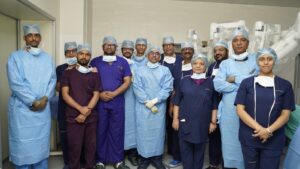
 Mukundapur, 11th May, 2026 : In a major clinical milestone, a specialist team at Narayana RN Tagore Hospital has successfully performed over 30 robotic renal transplants in obese patients- the highest number reported in Eastern India highlighting a significant advancement in managing high-risk Chronic Kidney Disease (CKD) cases.
In an equally significant achievement, the team also carried out a rare open kidney transplant under regional (spinal and epidural) anaesthesia on a 51-year-old conscious patient who was unfit for general anaesthesia, demonstrating the expanding possibilities of transplant surgery in complex clinical scenarios.
The dual advancements come at a time when India is witnessing a sharp rise in obesity and diabetes: two leading contributors to CKD. With nearly two lakh new CKD patients emerging annually, a large proportion eventually require kidney transplantation. However, obesity often makes patients high-risk candidates for conventional open surgery, leading to higher rates of post-operative complications and, in some cases, limiting their eligibility for transplant procedures.
Robotic-assisted transplantation using the Da Vinci Surgical System is helping bridge this gap by expanding clinical eligibility for transplantation. Patients who were previously considered high-risk due to obesity or co-morbidities can now undergo surgery with reduced chances of wound infection, smaller incisions, and faster recovery. Early mobilisation, often within 24 hours and shorter hospital stays significantly improve outcomes, making transplantation a more viable option for this vulnerable group.
Robotic transplantation in obese patients is technically complex. The procedure involves delicate vascular suturing (anastomosis), and longer operative times can increase the risk of temporary kidney dysfunction, such as acute tubular necrosis. The surgical team has worked to consistently minimise this time factor, achieving favourable outcomes from the very first case.
“Obesity significantly increases the risk of complications in traditional kidney transplantation. Robotic surgery allows us to minimise these risks, but it comes with its own technical challenges, especially in reducing the time taken for vascular connections. Our team has been able to address these challenges consistently from the very first case, ensuring positive outcomes,” said Dr. Tarshid Ali Jahangir, Consultant – General Surgery & Renal Transplant and Robotic surgery
“Such outcomes are the result of seamless coordination within a multidisciplinary team, where dedicated recipient and donor teams work in close alignment to manage the complexities of advanced transplant procedures. Robotic transplantation, particularly in high-risk and obese patients, requires not just surgical precision but a highly synchronized approach across specialties. The strength of our team lies in this collaboration, which enables us to take on challenging cases with confidence and deliver successful outcomes,” said Dr. Satyadip Mukherjee, Consultant – Urology & Robotic Surgery
In one of the most complex cases, the team performed an open transplant under regional anaesthesia on a 51-year-old patient with severe respiratory issues who had been denied clearance for general anaesthesia. Unlike conventional procedures, the patient remained awake and responsive throughout the surgery. The absence of complete abdominal relaxation and continuous respiratory movement made the procedure significantly more challenging, particularly during the critical anastomosis phase. Despite these constraints, the transplant was successfully completed, and the patient showed early recovery with stable graft function and mobilisation within days.
“This milestone reflects how clinical innovation can address real-world health challenges like obesity-linked kidney disease. It also highlights the importance of building integrated, multidisciplinary teams to deliver advanced care safely and effectively,” said Abhijit C. P., Director & Cluster Head – Kolkata and Corporate Growth Initiative, Narayana Health (East).
The success of both the high-volume robotic transplant programme and the complex anaesthesia case underscores the importance of coordinated teamwork among surgeons, anaesthesiologists, and support staff, especially in high-risk scenarios where conventional approaches may not be feasible.
“Innovations like robotic transplantation are not just about technology, but about expanding access to safe surgical care for patients who would otherwise have limited options. Such clinical advancements play a crucial role in improving outcomes in complex cases,” said R. Venkatesh, Group COO, Narayana Health.
As transplant medicine evolves, such advancements are expected to redefine surgical possibilities particularly for obese and high-risk patients ensuring that more individuals can safely undergo life-saving kidney transplantation.
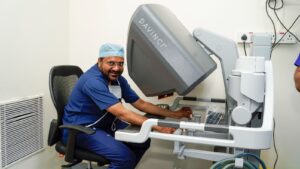
About Narayana RN Tagore Hospital, Mukundapur, Kolkata
Narayana RN Tagore Hospital, Mukundapur – Kolkata is a 681-bed, JCI & NABH-accredited superspecialty hospital located on the Eastern Metropolitan Bypass at Mukundapur. It is one of the leading hospitals in eastern India, operating in cardiac science (including heart transplantation), renal sciences (including kidney transplantation), GI Sciences (Including liver transplantation), Neurosciences, Comprehensive Cancer Care, Orthopaedics and other specialities.