
 October, 2026: ManipalCigna Health Insurance, one of India’s leading health insurers, has released insights specific to East India from India Health Quotient (IHQ) 2026, a study conducted by YouGov on behalf of ManipalCigna Health Insurance. The IHQ is a proprietary multi-dimensional index measuring self-assessed health across five dimensions: Physical, Mental, Financial, Occupational, and Social. The study covered 2,600 urban Indian respondents across 16 cities, including Kolkata, Guwahati, Patna and Bhubaneshwar from the eastern region.
India’s overall health score stands at 65 out of 100, while East India recorded an overall score of 66 (out of 100), making it the second-highest scoring region in the country. Across urban Indians, on the overall health scores, physical health remains the strongest dimension with a score of 68/100, while financial health stands at 62/100, highlighting the need for greater focus on financial preparedness as an integral part of overall wellbeing.
Sapna Desai, Chief Marketing Officer, ManipalCigna Health Insurance, said, “East India stands out for its strong focus on financial wellbeing and long-term preparedness. In Kolkata, 28% of respondents identify financial health as the most important dimension of their overall wellbeing, compared to 20% in other eastern cities (Guwahati, Patna & Bhubaneshwar). This heightened focus is also reflected in future-oriented behaviours, with more residents prioritising retirement planning and financial security. What is particularly encouraging is that this emphasis on financial wellbeing co-exists with strong mental and social wellbeing outcomes across the region, reinforcing the idea that people increasingly view health through a broader lens that includes emotional resilience, social connectedness and financial preparedness alongside physical health.”
East India demonstrates a balanced approach to wellbeing, with the region recording a Financial Health score of 63/100, above the national average of 62/100. The region also performs strongly on Mental Health (66/100) and Social Health (67/100), highlighting how financial preparedness is complemented by emotional wellbeing and social connectedness.
Financial priorities also vary within East India. Preparing financially for retirement features among the top 5 aspects for 50% of respondents in Kolkata, compared with 41% in the other eastern cities (Guwahati, Patna and Bhubaneshwar). On mental health, seeking help when support is needed features among the top 5 aspects for 50% of respondents in Kolkata, compared with 40% in the other eastern cities. These findings suggest that residents are not only thinking about financial security but are also taking a longer-term and more holistic view of wellbeing.
Beyond financial and mental wellbeing, East India also performs strongly on social wellbeing. Over half of the respondents from the region report high performance, rated very good or excellent, in feeling included and accepted in social settings, compared with 48% in the rest of India.
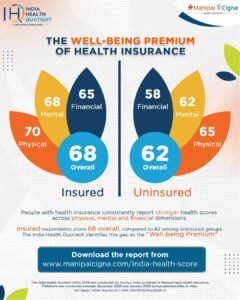
Beyond these regional findings, the study also reveals that health insurance ownership is one of the strongest predictors of overall wellbeing in India. Indians with health insurance score 68/100 on the India Health Quotient, compared to 62/100 for uninsured urban Indians, a 6-point gap that remains consistent across every cohort, region, age group, gender and stress level. Across the cohorts and stress levels tested in the study, insured Indians reported higher wellbeing scores than their uninsured counterparts on physical, mental and financial dimensions alike.
This “Wellbeing Premium” is notably larger than the gender gap (men and women both score 65/100) and exceeds regional differences between major metros like Mumbai (62/100) and Bengaluru (63/100). It also surpasses the gap between India’s youngest and oldest age groups (63/100 vs 65/100). The gap does not diminish even when controlling stress levels, suggesting that health insurance ownership is associated with meaningfully better wellbeing outcomes across all population segments.

The ManipalCigna India Health Quotient 2026 underscores the company’s commitment to going beyond traditional health insurance by developing a deeper, evidence-based understanding of how Indians experience wellbeing. With this, the company reaffirms its focus on building more responsive, holistic health solutions for a rapidly evolving India.